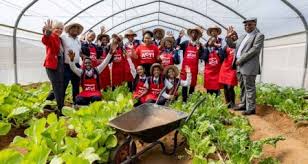
Grade 9 learners at Soshanguve Engineering School of Specialisation will gain hands-on agricultural experience through two new horticultural tunnels and a borehole, made possible through support from the Shoprite Foundation, and officially opened on 15 September 2026.
The Soshanguve expansion follows the Foundation’s first horticultural tunnel project at Oosrand Commerce and Entrepreneurship School of Specialisation, where approximately 5 000 units of produce have been harvested over the past two years for the school’s feeding scheme and sale to the surrounding community. More than 1 700 learners have received agricultural training.
“At Soshanguve Engineering, we want to give more young people the chance to experience agriculture for themselves. What’s particularly encouraging is that learners will not only leave the school with theoretical agricultural training, but also practical skills that will allow them to plant for sustenance.”
– Maude Modise, Director of the Shoprite Foundation
Forty Grade 9 learners will use the tunnels for agricultural training covering soil science, crop rotation, compost production, irrigation and pest and weed control.
MarketPlace Academy, the Foundation’s implementation partner, also trains educators as facilitators and supports the addition of an accredited plant production part-qualification to the CAPS curriculum.
“Learners already study agriculture at school, but an accredited plant production part-qualification also requires practical work. The tunnels give them a place to do that work. That means they can leave school with matric and a recognised qualification that gives them a first step into the industry.”
– Chantyl Mulder, CEO of MarketPlace Academy
This way of learning is already familiar at Soshanguve. Learners previously designed and built Modjadji, a solar-powered train that won the Engineering category at the Gauteng Schools of Specialisation Festival. The tunnels offer another setting for that learn-by-doing approach.
The school’s principal, Mr Tladi Mashiane, says schools can also help young people see how agriculture can contribute to food security. “The aim is for them to see agriculture not only as something they study, but as knowledge they can use at home, in further study or even to earn an income.”
The school also plans to use produce from the tunnels to supplement its feeding scheme, helping to reduce what it spends on food, Mashiane says. “Any surplus can be sold to the community, with the income invested back into the school.”
The Grade 9 learners are taking over from a pilot group that began working on the project last year. “I’ve learnt that growing food involves much more than just planting seeds and watering them,” says Zwanga Mpaphuli, 16, a Grade 11 learner who was part of that first group. “Things like temperature, soil quality, sunlight, pests and water management all make a difference.”
The school will manage the tunnels on a day-to-day basis, bringing the infrastructure the retailer provided to life.
The Foundation’s other school-based work includes its AI, Coding and Robotics Programme, which has reached more than 8 800 learners through seven labs in five provinces.