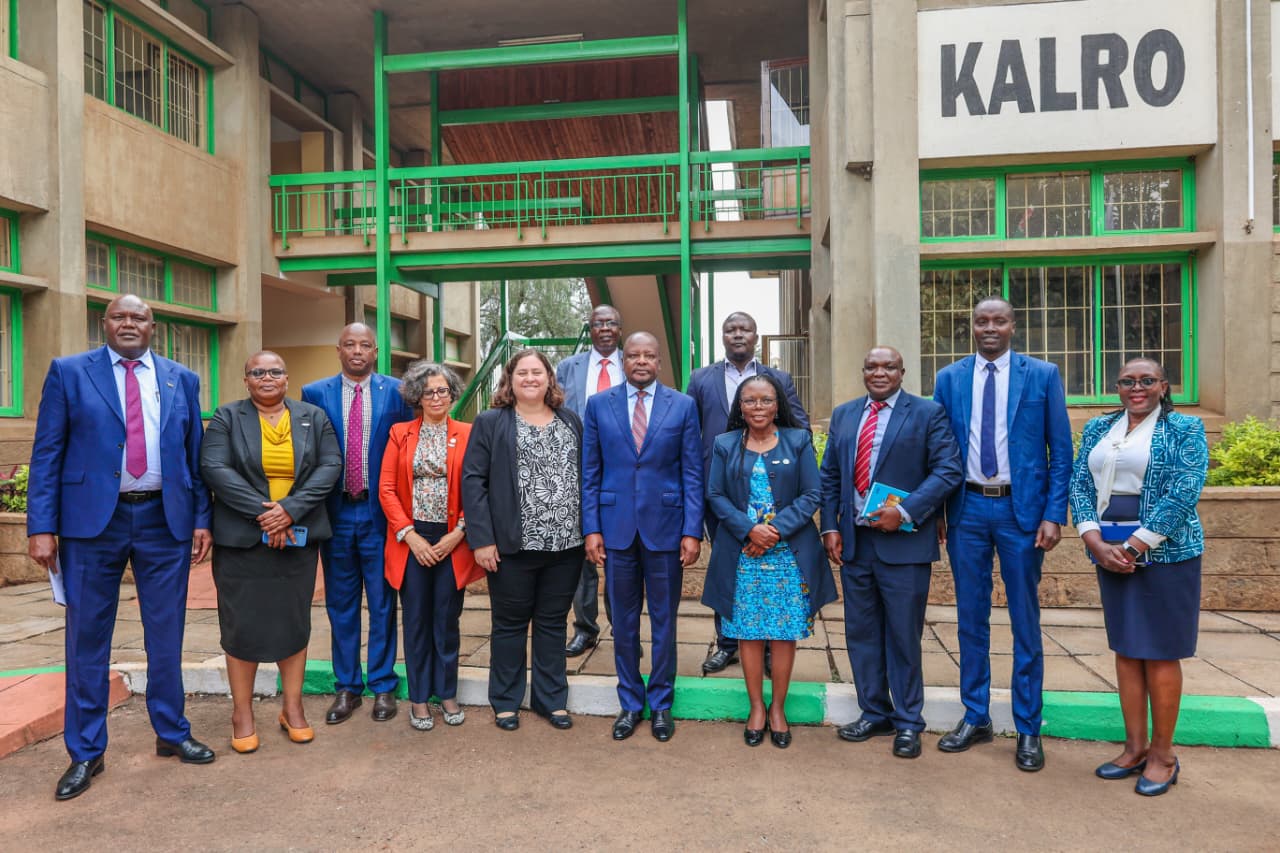
Today, at the Kenya Agricultural and Livestock Research Organization (KALRO), Kabete, Kenya launched three national initiatives: the Kenya Soil Partnership, Kenya Soil Laboratory Network and national rollout of the Global Soil Doctors Programme, to pave the way soil information is generated, shared and used.
As part of the Soil Mapping for Resilient Agrifood Systems (SoilFER) programme, the event also marked the unveiling and a tour to the newly renovated KALRO Kabete National Reference Soil Laboratory.
The SoilFER programme in Kenya is implemented in partnership with the Government of Kenya, FAO and KALRO, with financial support from the United States Department of State.
The High-level event brought all partners together to witness SoilFER advances in strengthening national soil data and laboratory systems, building technical capacity, and supporting farmers and decision-makers in transforming soil intelligence in recommendations and decisions for improved soil and fertilizer management.
“For a hundred years we have asked our soils what they can give us. Today we begin, at last, to ask them what they need,” CS Kagwe said.
“A bag of the wrong fertilizer, delivered on time, at half the price, to the wrong soil, is still the wrong fertilizer – Subsidy without a soil test is sympathy. It is not strategy.” CS Kagwe said.
Under SoilFER, Kenya has completed its national soil sampling campaign, with 3 672 soil samples collected, enhanced soil and GIS laboratories capacity including through facilities renovation and upgrading with advanced equipment. To date, over 100 technicians and experts have been trained in soil surveys, laboratory analysis and digital soil mapping.
“This project is futuristic; it looks at how we can sustainably use our soils to produce. Healthy soils translate to healthy crops that nourish healthy communities.” Ms. Melanie Thurber, Disaster and Humanitarian Advisor, United States Embassy in Nairobi.
But generating fresh data and information is only the beginning. Across three research stations and 50 trials on farmers’ fields, researchers are testing and refining soil and fertilizer management recommendations under local conditions. The aim is to move away from one-size-fits-all recommendations towards advice that reflects differences in soils, crops and farming conditions.
“For the first time, we are beginning to build a comprehensive national picture of Kenyan soils. This project will help us better understand our soils and utilize them optimally for agricultural production.” Dr Patrick K. Ketiem, Director General, Kenya Agricultural and Livestock Research Organization (KALRO)
The newly launched initiatives are intended to help carry this work forward and ensure sustainability and a long-lasting impact beyond SoilFER programme duration.
The Kenya Soil Partnership provides a country-driven multi-stakeholder platform bringing together government institutions, research organizations, universities, soil laboratories, farmer organizations, private sector actors and development partners to coordinate actions for sustainable soil management.
The Kenya Soil Laboratory Network promotes the harmonization of soil analysis methods and standards to ensure reliable and comparable soil data generated across laboratories through continued collaboration and capacity development.
At farm level, the Global Soil Doctors Programme takes soil knowledge directly to farmers through extension services and farmer-to-farmer learning. Training in Kakamega County has already reached 30 extension officers and more than 150 farmers, with the first phase aiming to reach 2 000 farmers across five counties.
“Together, we have opened a new path in Kenya: a path of soil intelligence, to guide farmers what to plant, where to plant and how to use fertilizer efficiently, and enable decisionmakers in adapting agricultural policies according to varying soil conditions” said Ms. Nora Berrahmouni, Deputy Director, Land and Water Division, FAO in her remarks.
“The launch of the Kenya Soil Partnership, the National Soil Laboratory Network and the Soil Doctors Programme marks an important step towards stronger soil governance, enhanced national capacity and accelerated progress towards sustainable agricultural transformation in Kenya.” said Farayi Zimudzi
The three-day programme in Nairobi continues with the first meeting of the national soil laboratory network and a technical assessment of wet and dry soil analysis.
SoilFER – Soil Mapping for Resilient Agrifood Systems – is a global programme operating in Ghana, Guatemala, Honduras, Kenya, Mozambique, Tunisia and Zambia with financial support from the Governments of the United States of America and Japan.